
How to Throw the Lead Hook (3)
Module 2 Lesson 4
Lesson Difficulty: ⭐⭐⭐ Beginner
Estimated Reading Time: 10-12 minutes
Recommended Practice Time: 15 minutes
Goal: Learn how to throw a lead hook using the correct technique, understand how body rotation creates power and discover when to use this effective close-range boxing punch.

Introduction to How to Throw the Lead Hook (3)
So far in the Beginner Boxing Academy, you've learned how to throw two straight punches: the jab (1) and the cross (2). Both punches travel directly towards your target and form the foundation of beginner boxing.
Now it's time to learn Punch Number 3 – the lead hook.
The lead hook is one of the most exciting punches in boxing because it attacks from a completely different angle. Instead of travelling in a straight line, it moves in a short, controlled arc, making it an excellent punch for landing around an opponent's guard or during close-range exchanges.
Many beginners think a hook is simply a wide swinging punch. In reality, a great lead hook is compact, balanced and powered by the rotation of your feet, hips and shoulders. When thrown correctly, it can become one of the fastest and most effective punches in your boxing toolkit.
In this lesson, you'll learn how to throw a lead hook with the correct beginner boxing technique, discover when to use Punch Number 3, understand how it generates power, and learn how to avoid the most common mistakes beginners make.
By the end of the lesson, you'll have another essential boxing skill to add to your growing collection—and you'll be one step closer to building smooth, effective boxing combinations.
What You'll Learn
By the end of this lesson, you'll understand how to throw a lead hook (Punch Number 3) with confidence and discover why it's one of the most effective punches in boxing.
You will learn:
✅ What a lead hook is and why it's called Punch Number 3
✅ Why the lead hook is so effective at close range
✅ How to throw a lead hook using the correct beginner boxing technique
✅ How your feet, hips and shoulders work together to generate power
✅ When to use the lead hook during training and boxing
combinations
✅ What a technically correct lead hook should feel like
✅ The most common mistakes beginners should avoid
✅ A simple home practice drill to improve your lead hook

What Is a Lead Hook?
The lead hook, also known as Punch Number 3, is a short, powerful punch thrown with your lead hand. Unlike the jab and cross, which travel in a straight line, the lead hook moves in a controlled arc towards the side of your target.
If you're an orthodox boxer (left foot forward), your lead hook is thrown with your left hand. If you're a southpaw (right foot forward), it's thrown with your right hand.
The lead hook is most effective at close to mid-range, where there's less distance between you and your opponent. It's often used to punch around the side of a guard, making it a valuable punch when straight punches are being blocked.
Although the lead hook can generate plenty of power, it's important to remember that good technique always comes first. A technically correct lead hook is compact, balanced and driven by body rotation rather than a wide swinging arm.
As you continue learning boxing, you'll discover that the lead hook is one of the most versatile punches in the sport. It can be used on its own, added to combinations or thrown after a jab and cross to attack from a new angle.
Key Takeaway
"Turn the corner."
The lead hook isn't a swinging punch.
Instead, imagine your punch travelling around the edge of your opponent's guard in one smooth, controlled movement.
Did you know
Let your feet and hips rotate naturally, keep your elbow in line with the punch and stay balanced throughout.
A short, compact hook is usually faster, more accurate and much more effective than a big looping swing.
Why Is The Left Hook So Important?
The lead hook gives you something your jab and cross can't...
A new angle of attack.
Instead of punching straight through the middle, the lead hook allows you to attack around the side of your opponent's guard.
This makes it an excellent punch when straight punches are being defended or when you're working at closer range.
The lead hook can be used to:
Punch around the guard.
Add variety to your attacks.
Continue combinations smoothly.
Create openings for other punches.
Catch an opponent by surprise with a change of angle.
As you gain experience, you'll realise that boxing isn't about throwing the same punch repeatedly. It's about recognising opportunities and choosing the right shot at the right time.
That's exactly where the lead hook becomes such a valuable part of your boxing.
Where You'll See This Punch
Watch experienced boxers, and you'll notice the lead hook used whenever the distance begins to close.
You'll often see it used to:
Follow a jab or cross during combinations.
Punch around an opponent's gloves.
Attack the head from the side.
Change the angle of an attack.
Finish a 1–2–3 combination.
The more boxing you watch, the more you'll notice that the lead hook isn't usually thrown on its own. Instead, it's often the punch that follows two straight punches, making combinations harder to defend.
Key Takeaway
Straight punches create opportunities. Hooks take advantage of them.
A good jab can measure distance.
A good cross can make your opponent react.
A well-timed lead hook can exploit the opening that's been created.
That's why the best boxers don't rely on one punch—they know which punch to throw next.
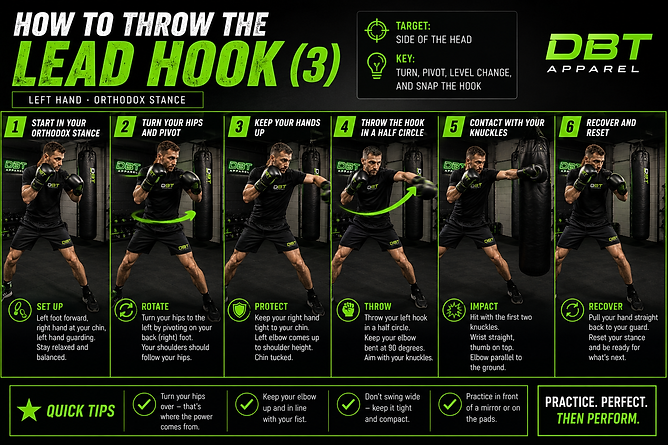
How to Throw a Cross
Now that you understand what the lead hook is and why it's such an effective punch, it's time to learn how to throw it correctly.
Unlike the jab and cross, the lead hook doesn't travel in a straight line. Instead, it moves in a short, controlled arc, powered by the rotation of your feet, hips and shoulders.
Remember, a great lead hook isn't about making the biggest movement possible. The best hooks are usually compact, balanced and thrown with excellent timing.
Take your time with each step and focus on smooth, controlled technique before thinking about speed or power.
Step 1 – Start in Your Boxing Stance
Begin in your normal boxing stance with your hands protecting your face and your knees slightly bent.
Stay relaxed and balanced, with your weight evenly distributed between both feet.
Your lead hand should already be in the perfect position to begin the hook.
Remember: Good balance creates good punches.
Step 2 – Rotate Your Lead Foot
As you begin the punch, allow your lead foot to pivot naturally.
This small movement helps your hips rotate safely and allows your body to generate power without placing unnecessary strain on your knee.
Don't force the pivot—let it happen as part of the movement.
Step 3 – Turn Your Hips and Shoulders
As your lead foot pivots, rotate your hips towards your target.
Your shoulders naturally follow, creating the power behind the hook.
Think of your upper body moving as one connected unit rather than throwing your arm independently.
Step 4 – Drive the Hook
Bring your lead arm around in a short, controlled arc.
Your elbow should stay bent at roughly 90 degrees, with your fist travelling around towards the target.
Keep the movement compact.
A shorter hook is usually quicker, more accurate and much easier to recover from.
Step 5 – Keep Your Rear Hand Up
While your lead hook is travelling, your rear hand should remain protecting your chin.
It's easy to forget about your opposite hand when concentrating on the punch, but keeping your guard high is an important habit to build from the beginning.
Step 6 – Return to Guard
As soon as the hook lands, bring your lead hand straight back to your guard.
Allow your hips and shoulders to return naturally to your boxing stance.
Finish balanced, relaxed and ready for your next movement.
Quick Coaching Checklist
Before moving on, ask yourself:
☐ Did my lead foot pivot naturally?
☐ Did my hips rotate before my arm?
☐ Was my hook short and compact?
☐ Did my rear hand stay protecting my chin?
☐ Did I stay balanced throughout?
☐ Did I return quickly to my guard?
If you can tick every box, you're building an excellent lead hook.
What It Should Feel Like
A well-thrown lead hook should feel short, smooth and powerful.
Unlike the jab and cross, which travel in a straight line, the lead hook should feel like your body is rotating naturally to create a new angle of attack. The movement should be compact, controlled and balanced from start to finish.
As you throw the punch, you should feel your lead foot pivot, your hips begin to turn and your shoulders follow. Your arm shouldn't be doing all the work. Instead, it should feel like your body is carrying the punch around in one connected movement.
When the hook lands, you should still feel balanced and ready to continue. Avoid falling forwards or allowing the punch to swing too wide. A good lead hook finishes quickly and returns straight back to your guard, ready for whatever comes next.
Try to imagine it like this:
Imagine you're turning to look at someone standing just beside you. Your feet stay grounded, your hips begin to rotate and your shoulders naturally follow. A technically correct lead hook uses that same connected body movement—it isn't a wild swing with your arm.
Remember...
The hook should feel like you're turning your body, not throwing your shoulder.
Think of it like this:
"Turn the corner."
Think about your punch travelling around the edge of your opponent's guard rather than straight through the middle.
Stay compact.
Stay balanced.
Then return straight back to your guard.
Common Beginner Mistakes
Learning what not to do is just as important as learning the correct technique.
Here are some common mistakes to watch out for when practising the lead hook.
❌ Swinging Your Arm
One of the biggest mistakes beginners make is trying to create power by swinging their arm in a big circle.
Instead: Keep the hook short and let your hips create the power.
❌ Forgetting to Pivot
Keeping your lead foot planted can make the hook feel awkward and place unnecessary strain on your knee.
Instead: Allow your lead foot to pivot naturally as your body rotates.
❌ Dropping Your Rear Hand
It's easy to forget about your guard while concentrating on your lead hand.
Instead: Keep your rear hand protecting your chin throughout the punch.
❌ Making the Hook Too Wide
A large looping hook takes longer to land and is easier to see coming.
Instead: Think short, sharp and controlled.
❌ Not Returning to Guard
A hook isn't finished when it lands.
Instead: Bring your hand straight back to your guard so you're ready for your next movement.
Angles create opportunities.
Straight punches travel directly towards the target.
Hooks allow you to attack from the side, making them an excellent choice when a straight path is blocked.
The more punches you learn, the more you'll realise that boxing isn't about throwing harder punches—it's about choosing the right shot at the right time.
Equipment Tip:
Hook and jab pads are one of the best training tools for developing your lead hook.
They encourage you to throw short, accurate punches while helping you improve your timing, rhythm and distance control.
If you're training on a punch bag, focus on smooth rotation and clean technique. A compact, technically correct hook will always be more effective than a wide swinging punch.

Beginners Tip: Your Challenge Today
Throw five slow lead hooks without thinking about power.
Now ask yourself one question:
Can you feel your hips beginning the movement before your arm starts to travel?
If the answer is yes, you're learning to generate power using your whole body rather than relying on your arm alone.
If not, slow the movement down even more. Sometimes the smallest adjustments create the biggest improvements.
Today's Challenge:
Complete 30 technically correct lead hooks while staying relaxed and balanced.
Try not to:
❌ Swing your arm.
❌ Forget to pivot your lead foot.
❌ Drop your rear hand.
❌ Make the hook too wide.
❌ Forget to return to your guard.
If you can complete all 30 while maintaining good technique, you're building a strong foundation for more advanced boxing combinations.
Reflection:
Take a moment to think about today's practice.
Ask yourself:
💭 Did my lead hook feel compact and controlled?
💭 Could I feel my hips creating the movement?
💭 Did I stay balanced throughout the punch?
💭 Did I keep my rear hand protecting my chin?
💭 Does my lead hook feel smoother now than when I started?
Remember, boxing is about making small improvements every time you train. Every technically correct repetition helps build confidence and develops habits that will stay with you as you progress.
What You've Learned
Excellent work!
You've now learned Punch Number 3 – the Lead Hook and added another important skill to your beginner boxing toolkit.
You now understand:
✅ What the lead hook is and why it's known as Punch Number 3.
✅ Why the lead hook is effective at close to mid-range.
✅ How to throw a lead hook with correct beginner technique.
✅ How your feet, hips and shoulders work together to create power.
✅ What a technically correct lead hook should feel like.
✅ The most common mistakes beginners should avoid.
✅ How to practise your lead hook safely and effectively at home.
You're no longer limited to straight punches—you've learned how to attack from a new angle.
Achievement Unlocked:
Completed Lesson 4
Congratulations!
Fantastic work!
The lead hook introduces a completely new skill to your boxing journey. Instead of relying on straight punches, you've learned how to create angles, rotate your body and deliver a compact, controlled hook.
By focusing on balance, technique and body rotation, you're building a punch that's fast, effective and ready to become part of your future combinations.
Keep practising little and often, trust the process and remember...
The right shot, at the right time, is always more effective than throwing every punch.