
BEGINNER BOXING • KIDS HOME
KIDS BOXING GEAR FOR HOME
Find the right boxing equipment for your child, based on their age, experience and how they want to train at home.
From first-time beginners wanting fun, to children who are becoming more serious, we'll help you choose the equipment that makes sense — without buying things they don't need.
Beginner Focused • Straightforward Guidance • UK Based

Not sure what your child needs?
Start with their age and training setup.
We'll show you what we'd recommend for kids boxing home training and why.

Just Starting Out
Your child is new to boxing? We'll show you the simple equipment we'd recommend to get them started at home.

Developing Their Skills
They're enjoying boxing and starting to learn more? See the equipment we'd recommend as their training develops.

Taking It Further
Your child is becoming more serious about boxing? Find out how to build a home setup that grows with their training.
Don't worry — that's exactly what we're here to help with. We'll guide you through the equipment we'd recommend for your child's age, experience and training space, explain why each item is useful, and help you avoid buying equipment they don't need yet.
Age is a guide — your child is unique.
Our age recommendations are a helpful starting point, not strict rules. Children grow at different rates, so hand size, build, comfort and training experience can all affect which equipment is right for them.
That's why we'll explain what we'd recommend, why, and what to look for throughout this page. Your child may be better suited to a smaller or larger glove, or may move from kids gel wraps to adult wraps earlier or later than another child.
Our goal is simple: help you choose the right equipment for your child, with confidence.
For a 5–8 year old who's just beginning:
Keep it simple, little is more to start with.
If your child is completely new, gloves and suitable hand protection are the starting point.
Essential Equipment

Boxing
Gloves
(6oz)
What is it?
6oz boxing gloves are a lighter-sized boxing glove designed for younger children. They're a suitable starting point for children around 5–8 years old who are beginning to learn boxing at home.
Why are we recommending it?
For a young beginner, we want their equipment to be age-appropriate, comfortable and easy to use.
6oz gloves are perfect for kids aged 5 - 8 years old to start learning. A suitable 6oz glove gives them the basic equipment they need to practise their stance, guard, movement, punches and simple start having fun with it.
When is it useful?
From their very first boxing sessions.
And importantly, your child doesn't need a punch bag to start boxing.
Gloves and suitable hand protection are enough to begin learning the fundamentals. They can practise their stance, guard, movement, individual punches, combinations and shadow boxing without needing to hit a target.
Does your child actually need it yet?
Yes — if they're ready to start practising boxing.
If your child is completely new, we'd recommend starting with 6oz gloves and suitable hand protection, rather than buying a whole collection of equipment straight away.
Once you know they're enjoying boxing and want to practise more, you can then consider adding a suitable target such as the kids inflatable free-standing punch bag.

Gel
Hand
Wraps
What is it?
Kids gel hand wraps are an easy-to-use form of hand protection designed to be worn underneath boxing gloves.
Why are we recommending them?
For young beginners, we want hand protection to be simple enough that parents and children can use it correctly and consistently.
Gel hand wraps provide an additional layer between your child's hands and their gloves.
When is it useful?
From the beginning of boxing training.
If your child is going to be wearing boxing gloves regularly, suitable hand protection should be part of their setup.
They're particularly useful for home beginners because they're quick to put on and easy to use, meaning less fuss before a training session.
Does your child actually need it yet?
If they're going to be regularly using boxing gloves, we'd recommend it.
For a very young child who's only trying boxing once, you may not need to buy a full setup immediately.
And remember: you don't need a punch bag yet.
Your child can begin learning their stance, guard, movement and punches without hitting a target.
FIRST ADDITION

Inflatable Free-Standing Punch Bag
What is it?
An inflatable free-standing punch bag gives your child a dedicated target to practise their punches against. Unlike a traditional hanging boxing bag, it can be placed on the floor and doesn't require you to install a heavy bag into a ceiling or wall.
Why are we recommending it?
Once your child has learned some basic boxing movements and is enjoying practising, having a target can make sessions more engaging and interactive.
For a younger child, we like this option because it provides a clear target without immediately turning your home into a full boxing gym.
When is it useful?
After your child has learned the basics and wants something to practise their punches on.
You can use it for simple drills such as:
Practising individual punches, working on combinations, they've already learned, improving accuracy, Practising, controlled punching, Adding short, fun boxing sessions at home
Does your child actually need it yet?
Not necessarily.
If your 5–8-year-old is completely new to boxing, gloves + suitable hand protection are enough to start.
They can learn their stance, guard, movement, punches, combinations and shadow boxing without a bag.
We'd consider adding the inflatable punch bag when your child is enjoying boxing, wants a target to hit and you're confident they're ready for it.
GEAR FOR LATER
SKIPPING
ROPE
What is it?
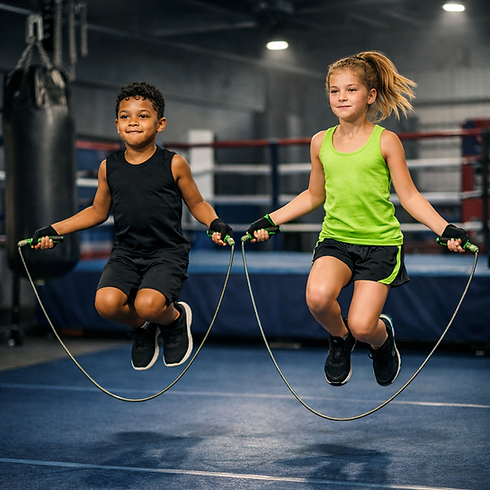
A skipping rope is a simple piece of training equipment that can help develop rhythm, coordination, movement and fitness.
Our skipping rope can be fully adjusted, making it possible to shorten it for a child rather than requiring a separate children's rope. This also means it can be adjusted again as they grow.
Why are we recommending them?
Skipping is closely associated with boxing because it helps develop some of the movement skills that boxers use during training.
For children, it can also make fitness and coordination work feel more like a fun activity rather than a formal workout.
We like the adjustable option because your child can grow with the rope, rather than quickly outgrowing a fixed-length children's rope.
When is it useful?
We'd introduce skipping after your child is comfortable with their basic boxing movement.
It can then be used for short, fun exercises such as:
-
Practising rhythm
-
Developing coordination
-
Introducing footwork
-
Warming up
-
Adding movement to a home boxing session
Does your child actually need it yet?
No — not when they're just starting.
For a 5–8-year-old who's never boxed before, we'd prioritise:
6oz gloves + kids gel hand wraps
Then, if they're enjoying boxing and want to develop their training, we'd consider the inflatable punch bag before adding more equipment.
The skipping rope can come later when they're ready to work on movement and coordination.

FOOTWORK
LADDER
What is it?
A boxing footwork ladder is a training ladder placed on the floor that can be used for simple movement and coordination drills.
For children, it can turn footwork practice into a fun, active challenge, helping them learn to move their feet with more control.
Why are we recommending them?
Good boxing isn't just about punching. How you move your feet is a big part of boxing, and a ladder gives children a visual target to help them practise where and how they place their feet.
For a young child, it can also make movement practice more enjoyable than simply being told to move backwards, forwards or sideways.
When is it useful?
We'd introduce a footwork ladder once your child is comfortable with their basic boxing stance and movement.
It can then be used for short drills such as:
-
Moving forwards and backwards
-
Side-to-side movement
-
Stepping in and out
-
Developing coordination
-
Making footwork practice more fun
It can also be a great piece of equipment for parent-and-child training, where Mum or Dad can call out simple movements for their child to follow.
Does your child actually need it yet?
No — not when they're just starting.
A 5–8-year-old can learn the fundamentals of boxing footwork perfectly well without a ladder.
If your child is still learning their stance and basic movement, we'd concentrate on those first.
The ladder becomes useful when they're enjoying boxing and you're looking for a way to make movement practice more varied and challenging.
Ages 8–11 Developing Their Skills
If your child is 8–11 and starting to enjoy boxing, you can begin to build their home training equipment around the skills they're developing.
Essential Equipment

Boxing
gloves
(8oz)
What is it?
8oz boxing gloves are a suitable next glove size for children around 8–11 years old, depending on their individual size, training and the guidance of their coach.
Why are we recommending them?
As children grow, their hands and training requirements change.
We don't want a parent simply buying the biggest glove available. We want them using a glove that's appropriate for their child and the training they're doing.
When is it useful?
From the point your child is ready for their next glove size.
They're suitable for general home practice, pad work and age-appropriate boxing training.
Does your child actually need it yet?
If they're still comfortably using correctly fitted 6oz gloves, not necessarily.
This is important.
We recommend 8oz for kids aged 8 - 11, but child development means they could be bigger or smaller.
Move up when the glove is no longer the right fit or when their training requirements change.
Gel
Hand
Wraps
What is it?
An easy-to-use form of hand protection worn underneath boxing gloves.
Why are we recommending them?
Because younger boxers can benefit from simple hand protection without needing to immediately learn traditional long hand wrapping.
As they grow older, kids will naturally become more powerful and their bones are still growing, protection is paramount.
When is it useful?
From the beginning of boxing training.
If your child is going to be wearing boxing gloves regularly, suitable hand protection should be part of their setup.
They're particularly useful for home beginners because they're quick to put on and easy to use, meaning less fuss before a training session.
Does your child actually need it yet?
If they're regularly using boxing gloves, we'd recommend them.
They're suitable for children 6–12 years old, so they continue to fit this age group.
Once your child reaches 12+, we'd look towards adult hand wraps instead.
FIRST ADDITION

hook &
jab pads
What is it?
Hook & jab pads, sometimes called punch pads, are handheld targets that a parent, coach or training partner can hold while the child practises their punches.
Why are we recommending them?
For an 8–11-year-old who is enjoying boxing, pads can add something a punch bag can't:
another person.
Mum, Dad or another suitable adult can hold the pads and call simple punches or combinations for the child to follow.
This can help make training:
-
More engaging
-
More interactive
-
More varied
-
A great parent-and-child activity
And because the target is being controlled by the person holding the pads, you can keep the exercises simple and age-appropriate.
When is it useful?
We'd introduce pads once your child understands their basic punches and combinations.
As their skills improve, the pad holder can introduce more combinations and movement.
It can turn a short home boxing session into something you can do together, rather than your child simply training alone.
Does your child actually need it yet?
No — but if they're enjoying boxing, this is one of the first additions we'd consider.
Your child can absolutely continue learning without pads.
But if they're asking:
"Can you hold something for me to punch?"
or they're starting to enjoy combinations and want to practise them with someone, this is a great time to introduce them.

Punching
Bag
What is it?
A boxing bag is a larger target that allows your child to practise their punches and combinations against resistance.
Why are we recommending it?
If your child is becoming more interested in boxing, a proper bag can give them a dedicated training target and make home sessions more varied.
It also gives them somewhere to practise combinations they've already learned — rather than simply throwing punches into the air.
For an 8–11-year-old who is becoming more serious, this can be a natural next step from gloves → pads → bag work.
When is it useful?
We'd consider a boxing bag when:
-
Your child already understands their basic punches
-
They're enjoying regular boxing practice
-
You have a suitable space
-
An adult can supervise their training
-
The bag can be safely installed and used
Does your child actually need it yet?
Not necessarily.
If your child is still a beginner, you don't need to rush into buying a full-size boxing bag.
They can get plenty from:
8oz gloves + hand protection + shadow boxing + pad work.
If they're becoming more committed and you have the appropriate space, then a boxing bag becomes a much more worthwhile investment.
GEAR FOR LATER
skipping
rope
What is it?
An adjustable skipping rope is a simple training tool that can be shortened to suit your child's height.
It can be used for skipping practice, warm-ups and boxing-style movement drills.
Why are we recommending it?
Skipping can help develop rhythm, coordination, footwork and fitness — all useful skills for a developing boxer.
The big advantage of the adjustable rope is that you can get the length right for your child and adjust it as they grow.
When is it useful?
Once your child is comfortable with their basic boxing movement, skipping can become a great addition to their training.
It can be used for:
-
Short warm-ups
-
Rhythm and coordination
-
Footwork practice
-
Fitness
-
Fun parent-and-child challenges
Does your child actually need it yet?
Not necessarily.
If your child is still developing their basic boxing skills, there's no need to rush into skipping.
But if they're enjoying boxing and you're looking for a simple way to introduce more movement, coordination and fitness, this is a useful addition.

SKIPPING
ROPES
A skipping rope is a simple addition to your gym boxing kit and a great way to warm up, improve coordination and build boxing fitness.
Why We Recommend Them
Skipping is a common part of boxing training and can help develop rhythm, footwork and cardiovascular fitness without taking up much space in your gym bag.
Beginner Tip
Start slowly and focus on rhythm rather than speed. Keep your jumps small and relaxed, and gradually increase the pace as your coordination improves.
FOOTWORK
LADDER
What is it?
A boxing footwork ladder is a ladder that sits flat on the floor and can be used for different movement and coordination drills.
Instead of simply practising boxing movement back and forwards, the ladder gives your child specific spaces to move through, making footwork practice more structured and engaging.
Why are we recommending it?
As children become more comfortable with their boxing stance and basic movement, we can start making their footwork more varied.
A ladder can help develop:
-
Coordination
-
Balance
-
Quick feet
-
Movement control
-
Rhythm
When is it useful?
At this age, 8 - 11, kids will naturally become more aware of basic boxing skills and their motor skills will suit a boxing footwork ladder.
This is a great edition to the home boxing workout kit and a great way to exert energy whilst developing better basic boxing footwork.
Does your child actually need it yet?
We'd introduce the ladder once your child is already comfortable with their basic boxing stance and movement.
You can then use simple drills such as:
Forward → backwards → sideways → in and out
before gradually introducing more challenging patterns.
It can also be used by parents as they're adjustable, so a great parent-and-child training kit, with Mum or Dad calling out the movement for their child to follow.
11 – 14 Taking Their Training Further
For children aged 11–14 who are becoming more interested in boxing, we can start building their home equipment around the skills they're developing.
At this age, some children may still be enjoying casual boxing at home, while others may be training regularly and becoming much more serious. There isn't one setup that suits every child.
Essential Equipment
Boxing
gloves
(10oz)
What is it?
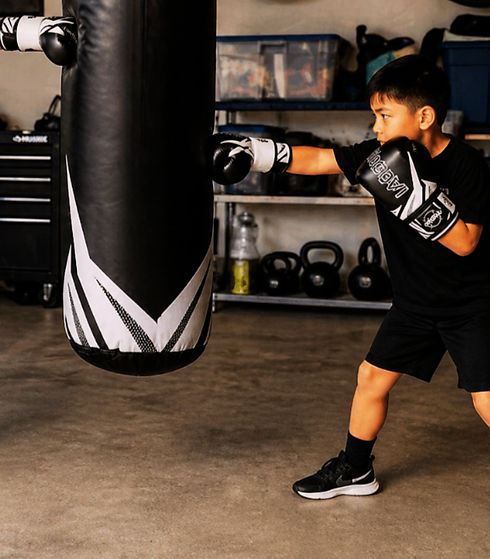
10oz boxing gloves are a natural next step for many children moving into the 11–14 age range. They're suitable for general beginner boxing practice, pad work and age-appropriate home training.
Why are we recommending it?
As children grow, their hands and overall build develop too. For many children aged 11–14, 10oz provides a sensible middle ground between the smaller 8oz glove and a larger 12oz glove.
But this is where our "age is a guide" message is important.
When is it useful?
10oz gloves can be used for general home boxing practice, pad work and controlled bag work.
However, the right glove size can depend on your child's hand size, build and the type of training they're doing.
A smaller child may still be more comfortable in 8oz gloves, while a larger child may be better suited to 12oz.
Does your child actually need it yet?
Not necessarily.
If your child is 11 and their 8oz gloves still fit comfortably and are appropriate for their training, there's no need to replace them simply because they've reached a certain age.
Equally, if they're larger for their age or their training has progressed, 12oz may be more appropriate.
The goal isn't to choose the biggest glove — it's to choose the right glove for your child.
Gel
Hand
Wraps
What is it?
Kids gel hand wraps are an easy-to-use form of hand protection worn underneath boxing gloves.
They're a simple alternative to traditional long hand wraps, making them particularly convenient for children training at home.
Why are we recommending them?
For many children aged 11–14, kids gel wraps can still provide a simple and convenient way to protect the hands underneath their gloves.
We don't believe parents should feel pressured into changing to adult wraps just because their child reaches a certain age.
If the kids gel wraps fit comfortably and are appropriate for their training, they can continue to be a good option.
When is it useful?
They're useful whenever your child is regularly training in boxing gloves.
At this age, they're particularly convenient for:
-
Home boxing sessions
-
Pad work
-
Bag work
-
Regular practice
However, as your child grows, their hands may become too large for kids gel wraps.
This is when adult gel hand wraps or adult hand wraps can become the better option.
Does your child actually need it yet?
Yes, hand protection is key, especially as they naturally grow and become stronger
If your child is still using kids gel wraps and they're comfortable, there's no need to change simply because they've reached 11.
However, is they're growing out of the kids gel wraps or you think your child is above average for their age, try the adults gel wraps.
FIRST ADDITION
hook &
jab pads
What is it?
Hook & jab pads, also known as punch pads, are handheld targets that a parent or training partner can hold while your child practises their punches.
Why are we recommending them?
At 11–14, your child may be ready to move beyond simply learning individual punches and start putting them together into longer combinations.
Pads give them an opportunity to practise:
-
Combining different punches
-
Accuracy
-
Timing
-
Controlled punching
-
Following instructions
-
Working with a moving target
They're also a fantastic way to keep parent-and-child training involved at home.
The difference at this age is that we're not just using the pads because they're fun — we're using them to develop skills your child has already started learning.
When is it useful?
Once your child understands their basic punches and combinations, pads can become a regular part of their home training.
For example, Mum or Dad might call:
Jab → Cross
then progress to:
Jab → Cross → Lead Hook
and eventually introduce combinations your child has already learned through their boxing training.
You can also introduce simple movement — such as asking your child to move after completing a combination.
Does your child actually need it yet?
No — but we'd strongly consider it if they're becoming more serious about boxing.
Your child can continue developing with shadow boxing and a punch bag without pads.
But if they're enjoying boxing, learning combinations and want to practise with someone else, pads can add a completely different dimension to their training.

Punch
Bag
What is it?
A boxing bag provides a dedicated target for your child to practise punches and combinations against resistance.
Unlike shadow boxing, it gives them something physical to work with, allowing them to practise accuracy, combinations, rhythm and controlled punching.
Why are we recommending it?
At 11–14, a child who is becoming more committed to boxing may benefit from having a dedicated training target at home.
They're likely to have developed a wider range of punches and combinations, so a bag gives them somewhere to put those skills into practice.
.
When is it useful?
A boxing bag becomes particularly useful when your child:
-
Is training regularly
-
Understands their basic punches and combinations
-
Wants to practise independently
-
Has suitable space at home
-
Has appropriate adult supervision
It's especially suited to a garage or dedicated training area, where there's enough room around the bag to move safely.
Does your child actually need it yet?
No — but it can become a very worthwhile addition at this age.
If your 11-year-old is only occasionally practising boxing, they can still get plenty from:
gloves + hand protection + shadow boxing + pad work.
But if they're training regularly and becoming more serious, a boxing bag can give them another way to practise and structure their sessions.
And if they're still training in a bedroom or small living space, don't buy the bag simply because they're 11.
SKIPPING
ROPES
A skipping rope is a simple addition to your gym boxing kit and a great way to warm up, improve coordination and build boxing fitness.
Why We Recommend Them
Skipping is a common part of boxing training and can help develop rhythm, footwork and cardiovascular fitness without taking up much space in your gym bag.
Beginner Tip
Start slowly and focus on rhythm rather than speed. Keep your jumps small and relaxed, and gradually increase the pace as your coordination improves.
skipping
rope
What is it?
An adjustable skipping rope is a training tool that can be adjusted to suit your child's height.
It's commonly used by boxers as part of their warm-up and fitness training and can be adapted as your child grows, even taking it into adulthood.
Why are we recommending it?
By 11–14, many children are beginning to develop better coordination and movement skills.
A skipping rope can help them work on:
-
Rhythm
-
Coordination
-
Footwork
-
Balance
-
Fitness
-
Endurance
It's also a simple piece of equipment that can be used almost anywhere with a little space.
When is it useful?
A skipping rope is particularly useful when your child is:
-
Training regularly
-
Looking to improve their movement
-
Building their boxing fitness
-
Warming up before training
At this age, many children start to enjoy setting themselves small challenges and goals, making skipping a great way to track improvement over time.
Does your child actually need it yet?
No.
Your child can still learn boxing perfectly well without a skipping rope.
But if they're enjoying boxing and want to improve their movement and fitness, it's one of the simplest and most affordable additions you can make to their setup.
GEAR FOR LATER
FOOTWORK
LADDER
What is it?
A boxing footwork ladder is a floor-based training tool used for movement and coordination drills.
It gives your child specific spaces to move through, allowing them to practise different footwork patterns in a controlled way.
Why are we recommending it?
At 11–14, your child may be ready to make their footwork more challenging.
The ladder can help develop:
-
Coordination
-
Balance
-
Rhythm
-
Foot speed
-
Movement control
-
Agility
It can also make repetitive footwork practice more enjoyable by turning it into different drills and challenges
When is it useful?
We'd introduce a footwork ladder when your child is already comfortable with their basic boxing stance and movement.
They can then use it to practise things such as:
Forward → backwards → sideways → in and out
and gradually progress to more challenging patterns.
Does your child actually need it yet?
No — it's still an optional progression tool.
Your child doesn't need a footwork ladder to learn boxing or become fitter.
But if they're training regularly and want to develop their movement further, it's a useful addition that can make footwork practice more varied and challenging.

HEAD
SPEED BALL
What is it?
A head speed ball is a moving boxing target that reacts when your child punches it.
Unlike a standard punch bag, the target moves back towards them, meaning they need to watch the target, time their punches and control their movements.
Why are we recommending it?
By 11–14, some children may have developed enough basic boxing skills and coordination for a moving target to become genuinely useful.
Rather than simply hitting a stationary target, the speed ball introduces a different challenge:
Watch → react → punch → recover → repeat.
It can help develop:
-
Hand-eye coordination
-
Timing
-
Accuracy
-
Reaction
-
Rhythm
-
Controlled punching
When is it useful?
We'd consider introducing a speed ball when your child is already comfortable with:
-
Their basic punches
-
Simple combinations
-
Their boxing stance
-
Basic movement
-
Controlling their punches
Does your child actually need it yet?
No — even at 11–14, it's still optional.
This is really important.
Being 11 doesn't automatically mean your child is ready for a speed ball.
If they're still developing their fundamentals, there's much more value in continuing with:
Gloves → hand protection → pads → bag work → movement
Build Your Home Boxing Setup
Mix and match your own combination.
No code to remember. Pick the equipment you actually want and we'll take care of the discount at checkout.
By now, you should have a better idea of the equipment you need for your home boxing training. So, you're probably wondering how much it will all cost.
Choose the beginner boxing equipment that suits your training and build your own setup. With our Mix 'n' Match promotion, you'll automatically receive an extra 10% off at checkout when you spend £50 or more — even on items that are already discounted.




Quick Tips for Kids Beginner Boxing at the Home
When kids are starting out boxing training at home its important for them to have fun.
But as a parent, there will be lots of questions you need answering, we recommend having fun with them too, but some questions you may want answers to, find more info on kids boxing training from home here.
Kids Home Boxing Equipment FAQs
Kids starting boxing at home can raise a few questions, especially when you're deciding what equipment you actually need or how they can train. We've answered some of the most common beginner questions below to help you choose your equipment with confidence.